
The Invisible Kitchen: Designing Timeless Spaces
- Apr 6
- 3 min read
Updated: Jul 28
In luxury interiors, the most successful spaces are often the ones you don’t immediately notice. They don’t demand attention through bold gestures or excessive detail. Instead, they feel calm, resolved, and intuitive. Nowhere is this more powerful than in the kitchen, arguably the most complex space in the home.
The concept of the Invisible Kitchen is not about minimalism for its own sake. It’s about clarity. It’s about removing visual noise so that what remains feels intentional, architectural, and quietly refined.
Designing Beyond Appliances
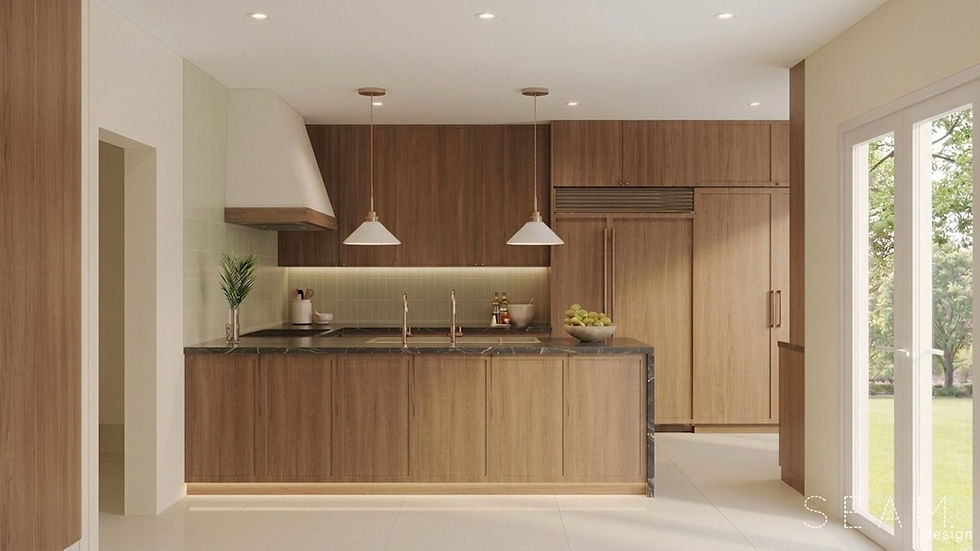
A traditional kitchen is often defined by its parts: appliances, cabinetry, and fixtures. An invisible kitchen shifts that mindset. Instead of designing around appliances, the goal is to integrate them into a continuous architectural language.
Refrigeration becomes part of a wall, not a focal point.
Ventilation is concealed or expressed as a sculptural element.
Storage disappears into seamless millwork.
The result is a kitchen that reads as a unified volume rather than a collection of objects.
The Role of Material Consistency
Material transitions are where visual clutter often begins. In an invisible kitchen, restraint is key:
One primary wood tone or finish.
One dominant stone surface.
Minimal contrast, used with precision.
This doesn’t mean the space lacks depth; it means depth is created through texture, grain, and light, rather than contrast. When materials feel continuous, the space feels larger, calmer, and more intentional.
Storage as a Design Strategy
Luxury is not just what you see; it’s what you don’t. An invisible kitchen relies heavily on highly resolved storage:
Full-height cabinetry that eliminates visual breaks.
Integrated handles or touch-latch systems.
Dedicated zones for small appliances to remain concealed.
This approach allows countertops to remain clear, reinforcing the sense of calm and order.
Lighting That Disappears Into the Architecture
Lighting in these spaces is never decorative first; it is atmospheric. Instead of statement fixtures dominating the room, lighting is layered subtly:
Recessed ceiling lighting for overall clarity.
Concealed under-cabinet lighting for function.
Soft ambient glow to emphasize materiality.
Even when pendants are introduced, they are selected to complement the architecture, not compete with it.
Why This Approach Feels Luxurious
True luxury in modern interiors is shifting away from excess and toward effortlessness. An invisible kitchen feels:
Calm rather than busy.
Intentional rather than decorated.
Timeless rather than trend-driven.
It reflects a deeper level of design thinking, where every decision has been resolved, refined, and reduced to its essential form.
The Emotional Connection to Space
Creating an invisible kitchen is not just about aesthetics; it’s about fostering an emotional connection to the space. When we walk into a kitchen that feels cohesive and thoughtfully designed, we experience a sense of peace. This tranquility invites us to engage more fully in the activities that take place there, whether cooking, entertaining, or simply enjoying a quiet moment.
The Importance of Functionality
Functionality is at the heart of the invisible kitchen. Every element should serve a purpose while maintaining the overall aesthetic. This balance between beauty and practicality is what makes a kitchen truly luxurious. When the layout flows seamlessly, and every item has its place, the kitchen becomes a sanctuary rather than a source of stress.
Integrating Technology Discreetly
In today’s world, technology plays a significant role in our kitchens. However, it should not disrupt the visual harmony. The invisible kitchen embraces technology by integrating it discreetly. Smart appliances can be hidden behind cabinetry, and control systems can be designed to blend seamlessly with the overall aesthetic. This way, we can enjoy the benefits of modern conveniences without compromising the serene environment.
Conclusion
The Invisible Kitchen is not about having less; it’s about designing better. It requires precision, discipline, and a clear understanding of how people live within a space. When done well, the result is a kitchen that doesn’t compete for attention but instead elevates the entire home.
At SEAM.design, we approach kitchens as architectural experiences—spaces that feel seamless, intuitive, and quietly luxurious. Our goal is to create refined, bespoke environments that resonate with your lifestyle.
By focusing on clarity and intentionality, we can transform your kitchen into a timeless space that reflects your unique taste and enhances your daily life. Together, let’s create a kitchen that feels like an extension of your home, where every detail is thoughtfully considered and beautifully executed.


Comments